Tuesday, September 1, 2009

Solar power, education, inflation, and majors

China is really pushing the production of solar panels. Siemens has also invested a lot of money into solar power recently. I've heard people say that oil prices will only go up in the long term, but I wonder if energy prices will actually go down.

Some people talk about why the price of upper education has risen.

As the economy bottoms out, we look more towards inflation. With slow growth, I don't expect inflation to get out of control, though even if that were the case it seems to be a necessary condition for growth in this recovery period.

College students fret about their majors. I thought this has always been a problem for them, especially for liberal arts people.

Thursday, August 27, 2009

Water, TARP, incentives, and Austin.

Here's an interesting article on the issue of water in Latin America.

Here's a look at TARP funds--they were actually used to make loans! Some were afraid this may not be the case for very much of the funds.

A TED talk (those things are great) by Dan Pink, former speechwriter for Al Gore. He talks about incentives, and how they can hurt. Also follow the links for similar talks by Dan Ariely.

Austin, TX looks like it's going to rebound this year, too. News for Texas looks relatively rosy.

Wednesday, August 26, 2009

The rich, Bernanke, unemployment, and cell phones

Over the past two years, the rich have not gotten richer, ending a 30-year rise.

Bernanke is apparently optimistic on near-term growth. That shouldn't be a surprise to anyone, I think. There's a lot of reason to be optimistic, it seems.

Unemployment rose in 26 states.

Another development article: the solar-powered cell phone. I always thought heat was detrimental to the lifespan of electronics--though, I guess a solar-powered cell phone makes more sense than a wind powered or hydroelectric cell phone. Still, there are small solar cells you can buy to charge small electronics. Why not just replace the car charger (or whatever) with a solar charger?

Tuesday, August 25, 2009

Silver bullets, aid money, institutional reform, and Texas

Dennis Whittle tell us about the attraction and myth that is the developmental silver bullet.

Here's an interesting graphic on monetary flows of developmental aid. Aid in Israel has shrunk a lot, apparently.

Another of development: William Easterly reminds us that institutional reform may help developing nations, but we don't know what that means. I disagree that the term is meaningless, though. It helps us to narrow down what types of reforms might be most helpful, and then a more detailed analysis of the factors of institutional reform may help us pin down specific actions.

The economy in Texas is looking strong! Or, at least, looking to rebound soon. I don't expect commercial real estate construction to start up very strongly soon, though.

Monday, August 24, 2009

Health care, global health care, job losses, love, and ham

Myths of health care reform. It seems like there are a lot of scare tactics.

While discussion on domestic health care policy is fierce, Ruth Levine reminds us about global health care policy.

Back here, job loss claims are slightly up, while the overall unemployment rate is down slightly. I'm hoping that we avoid 10%.

Love is worth over a quarter million dollars.

What would your bank do if you offered them wine and ham as collateral?

Friday, August 21, 2009

Job markets, mortgage default rate, credit, and spending

Insight's best and worst job markets. It's nice that the page is continually updated, too.

13%? That's a very high mortgage default rate. And it's not supposed to peak until at least a year from now. CalculatedRisk tells us that the problem is growing to fixed rate prime loans. Yikes! That last link also shows rates per state.

Banks are cutting credit limits for 58 million card holders. I've also heard that they're raising the rates that they charge companies who use their credit card services for payments. This sort of thing isn't a surprise, due to recent credit card reform, and this is probably a good sign.

Here's a neat graphic: how the average consumer spends his paycheck. It's actually a "consumer unit," which is apparently about 2.5 people with 1.3 earners.

Thursday, August 20, 2009

Development, savings rates, and billions of dollars

Charles Kenny, via William Easterly, on the successes of development. If you're down on development issues, this is a very worthwhile read.

Speaking of development, check out Intel's Small Things Challenge. It's kind of like the free rice site, except Intel donates money to a couple of charities, and if they get enough clicks, then they donate $300,000.

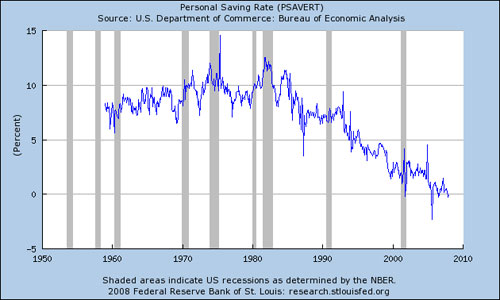
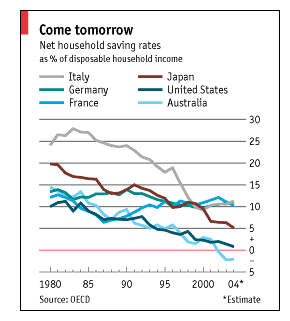
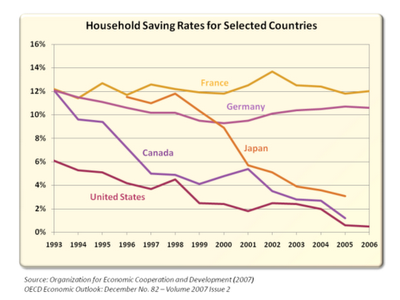
On an unrelated note, the personal savings rate was at a 15 year high this past quarter. It's still nowhere near where it used to be from the 60s to the 80s. I haven't looked at much international data, but it looks like a lot of countries are pretty low.

Here's a visualization of the billions of dollars that are spent on a variety of things.