Myths of health care reform. It seems like there are a lot of scare tactics.
While discussion on domestic health care policy is fierce, Ruth Levine reminds us about global health care policy.
Back here, job loss claims are slightly up, while the overall unemployment rate is down slightly. I'm hoping that we avoid 10%.
Love is worth over a quarter million dollars.
What would your bank do if you offered them wine and ham as collateral?
Monday, August 24, 2009


Friday, August 21, 2009
Job markets, mortgage default rate, credit, and spending
Insight's best and worst job markets. It's nice that the page is continually updated, too.
13%? That's a very high mortgage default rate. And it's not supposed to peak until at least a year from now. CalculatedRisk tells us that the problem is growing to fixed rate prime loans. Yikes! That last link also shows rates per state.
Banks are cutting credit limits for 58 million card holders. I've also heard that they're raising the rates that they charge companies who use their credit card services for payments. This sort of thing isn't a surprise, due to recent credit card reform, and this is probably a good sign.
Here's a neat graphic: how the average consumer spends his paycheck. It's actually a "consumer unit," which is apparently about 2.5 people with 1.3 earners.
13%? That's a very high mortgage default rate. And it's not supposed to peak until at least a year from now. CalculatedRisk tells us that the problem is growing to fixed rate prime loans. Yikes! That last link also shows rates per state.
Banks are cutting credit limits for 58 million card holders. I've also heard that they're raising the rates that they charge companies who use their credit card services for payments. This sort of thing isn't a surprise, due to recent credit card reform, and this is probably a good sign.
Here's a neat graphic: how the average consumer spends his paycheck. It's actually a "consumer unit," which is apparently about 2.5 people with 1.3 earners.
Thursday, August 20, 2009
Development, savings rates, and billions of dollars
Charles Kenny, via William Easterly, on the successes of development. If you're down on development issues, this is a very worthwhile read.
Speaking of development, check out Intel's Small Things Challenge. It's kind of like the free rice site, except Intel donates money to a couple of charities, and if they get enough clicks, then they donate $300,000.
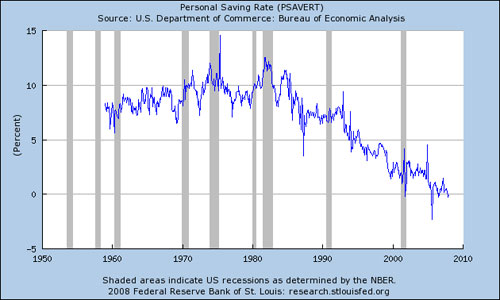
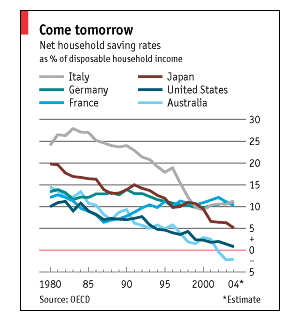
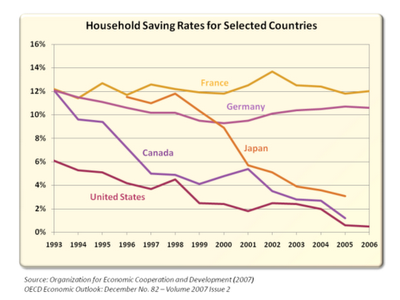
On an unrelated note, the personal savings rate was at a 15 year high this past quarter. It's still nowhere near where it used to be from the 60s to the 80s. I haven't looked at much international data, but it looks like a lot of countries are pretty low.
Here's a visualization of the billions of dollars that are spent on a variety of things.
Speaking of development, check out Intel's Small Things Challenge. It's kind of like the free rice site, except Intel donates money to a couple of charities, and if they get enough clicks, then they donate $300,000.
On an unrelated note, the personal savings rate was at a 15 year high this past quarter. It's still nowhere near where it used to be from the 60s to the 80s. I haven't looked at much international data, but it looks like a lot of countries are pretty low.

Here's a visualization of the billions of dollars that are spent on a variety of things.
Wednesday, August 19, 2009
Subprime mortgages, the end of the recession, FDI, and health care
The Cleveland Fed presents us with ten myths about subprime mortgages.
Mark Thoma tells us when we'll know that the recession is over. I think there are two important themes: 1) it's tough to tell, and 2) it'll be pretty obvious when it's there.
Foreign investment in long-term US bonds are up. Although China is pulling out some of its money, the scare that everyone wants to pull out their money and ruin the US is unfounded. Sometimes, economics is telling people the obvious, when they want to believe the ludicrous.
The public health care option may be off the table. Back to high health care expenditures? Have congressional Republicans attempted to make any concessions at all? Bipartisanship seems to imply compromise.
Mark Thoma tells us when we'll know that the recession is over. I think there are two important themes: 1) it's tough to tell, and 2) it'll be pretty obvious when it's there.
Foreign investment in long-term US bonds are up. Although China is pulling out some of its money, the scare that everyone wants to pull out their money and ruin the US is unfounded. Sometimes, economics is telling people the obvious, when they want to believe the ludicrous.
The public health care option may be off the table. Back to high health care expenditures? Have congressional Republicans attempted to make any concessions at all? Bipartisanship seems to imply compromise.
Tuesday, August 18, 2009
Good news on the recession, sugar, bubbles, and new homes.
A few pieces from Capital Gains and Games. Some thoughts on the unemployment numbers--getting worse slower isn't getting better. Still, I prefer getting worse slower. Still, the prospect that the unemployment rate won't hit 10% is great. The deficit would have been the same under Bush (or McCain) and is likely going to be less than originally forecast. So, it was largely unavoidable. Still, I hope that our money was put to good use.
A reduction in the supply of sugar is causing prices to increase. If there are profits to be made, then we'd expect other firms enter the market. Good sign for South American and African sugar farmers?
The Business Pundit speculates at the next possible bubble to burst. Gold seems a little far fetched to me, as I always thought of gold as a back-up place to store wealth, which means that it'd be more of an effect than a cause of speculation.
Felix Salmon reminds us that a home is not an investment as Krugman buys a new place. I've seen it argued that people thinking of homes as investments is a part of what caused the housing crisis.
A reduction in the supply of sugar is causing prices to increase. If there are profits to be made, then we'd expect other firms enter the market. Good sign for South American and African sugar farmers?
The Business Pundit speculates at the next possible bubble to burst. Gold seems a little far fetched to me, as I always thought of gold as a back-up place to store wealth, which means that it'd be more of an effect than a cause of speculation.
Felix Salmon reminds us that a home is not an investment as Krugman buys a new place. I've seen it argued that people thinking of homes as investments is a part of what caused the housing crisis.
Monday, August 17, 2009
Healthcare, good income news, good recession news, and blips.
Chris Dillow looks at the relationship between health care spending as a percentage of GDP and life expectancy. It's not the whole story, of course, but it does start an interesting discussion.
Real average hourly earnings is up a lot. Presumably, firms are holding on to qualified workers. We'll see how this measure holds out against the unemployment rate.
The chances of positive GDP growth are up! According to a Philly Fed survey. It's been a long recession.
Capacity utilization has a small up-blip, and industrial production is up. This, honestly, doesn't tell us much. If it continues up, that's a good sign, but this increase is probably too small to indicate anything.
Real average hourly earnings is up a lot. Presumably, firms are holding on to qualified workers. We'll see how this measure holds out against the unemployment rate.
The chances of positive GDP growth are up! According to a Philly Fed survey. It's been a long recession.
Capacity utilization has a small up-blip, and industrial production is up. This, honestly, doesn't tell us much. If it continues up, that's a good sign, but this increase is probably too small to indicate anything.
Friday, August 14, 2009
Unemployment rate <10%, income distribution, IV, the recession's end, and unemployment again
Nate Silver makes the claim that the unemployment rate won't hit 10%. Bold, considering there are many expecting it to go well above 10%.
People in the top .01% have 6% of the nation's income, the highest ever. It's interesting how it was so low for so long.
The Economist has an interesting article on instrumental variables. The gist: they attain more accurate answers to less broad questions. Instrumental variables are tools, however. We should never rely on one tool in our toolbox--that has always led us astray. That's just like articles bashing macroeconomics due to "bad" econometric forecasting.
According to this graph, a lot of economists seem to think that the recession is over. That's the WSJ, though, so take that with a grain of salt. The more interesting part, in my opinion, is that the unemployment predictions, on average, don't hit 10%. More predictions here.
People in the top .01% have 6% of the nation's income, the highest ever. It's interesting how it was so low for so long.
The Economist has an interesting article on instrumental variables. The gist: they attain more accurate answers to less broad questions. Instrumental variables are tools, however. We should never rely on one tool in our toolbox--that has always led us astray. That's just like articles bashing macroeconomics due to "bad" econometric forecasting.
According to this graph, a lot of economists seem to think that the recession is over. That's the WSJ, though, so take that with a grain of salt. The more interesting part, in my opinion, is that the unemployment predictions, on average, don't hit 10%. More predictions here.

Subscribe to:
Posts (Atom)